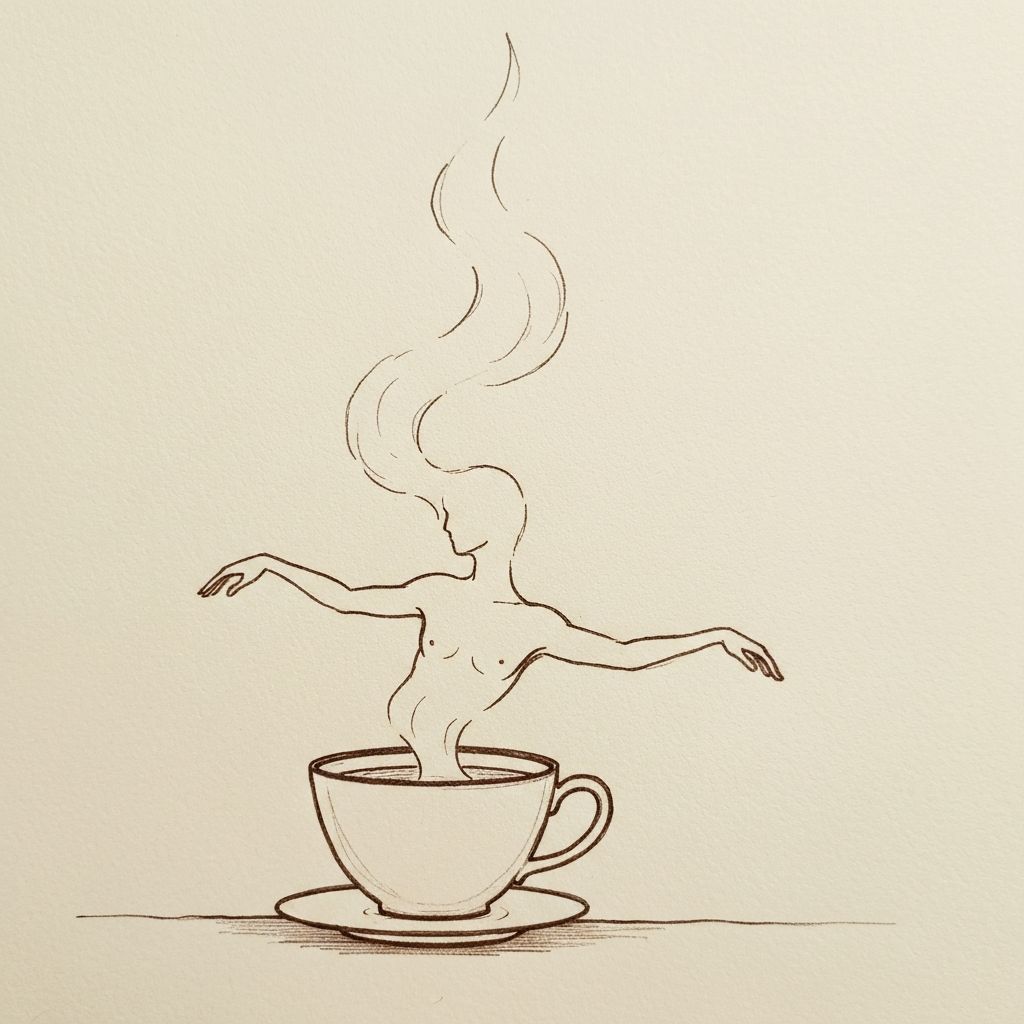
Presence
Presence and Tea
The Practice of Being Here
Presence is not a skill you acquire. It is a state you return to. Every contemplative tradition in human history has pointed toward the same truth: the quality of your attention determines the quality of your life. Tea is one of the oldest technologies for training that attention.
Why presence has become radical
The Attention Crisis
Johann Hari, in Stolen Focus, documents how the average American's attention span has collapsed from 12 seconds to 8 seconds in a single generation. We are interrupted every 65 seconds. We check our phones 2,617 times a day. Our nervous systems are in a state of chronic partial attention. In this context, the act of sitting with a cup of tea for five minutes, without looking at a screen, becomes radical. Not because tea is magic. But because unbroken attention is now rare. And rare things are valuable. The tea ceremony was designed for a different era, but it addresses our era's deepest need: the capacity to be fully present in a single moment.

“Your experience of being alive consists of nothing other than the sum of everything to which you pay attention.”
Oliver Burkeman
Four Thousand Weeks: Time Management for Mortals, 2021
Why embodied presence requires a container
Mindfulness Is Not Enough
The mindfulness movement has done important work. But there is a limit to sitting on a cushion and watching your breath. The philosopher Evan Thompson argues in Waking, Dreaming, Being that true presence is not merely cognitive. It is embodied, relational, and situated. You cannot be present in the abstract. You are present to something. The tea ceremony provides that something. The weight of the cup. The temperature of the water. The color deepening in the bowl. The aroma shifting with each second. The taste evolving on the tongue. These are anchors. They give presence a place to land. This is why tea is not just a mindfulness aid. It is a complete practice. It engages all five senses simultaneously, grounding attention in the body rather than the mind.

“The real voyage of discovery consists not in seeking new landscapes, but in having new eyes.”
Marcel Proust
In Search of Lost Time
How safety enables presence
Polyvagal Theory and the Tea Moment
Stephen Porges' Polyvagal Theory explains that the nervous system must feel safe before it can be present. When the vagus nerve senses threat, the body mobilizes for fight or flight. Presence is impossible in this state. Tea ceremony creates conditions of safety. Warmth in the hands activates the ventral vagal pathway. A quiet environment reduces amygdala activation. The ritual's predictability signals safety to the nervous system. The parasympathetic response that follows is not just relaxation. It is the precondition for presence. This is the science behind POUR's philosophy. When we say tea supports presence, we are describing a neurobiological process. The warm cup, the quiet space, the meditative rhythm of the ritual: they are telling your nervous system it is safe to be here now.

The Presence Protocol
- 01Prepare your space: Clear the table. Remove devices. Close the door.
- 02Boil water. Listen to the sound change as temperature rises.
- 03Measure leaves. Feel their texture. Smell them dry.
- 04Pour water slowly. Watch the leaves unfurl.
- 05Wait. Do nothing. Not even thinking about doing nothing.
- 06Lift the cup. Notice the weight. The warmth.
- 07First sip: hold it in your mouth for 3 seconds before swallowing.
- 08After finishing: sit with the empty cup for 60 seconds. Notice what remains.
POUR's core proposition
Presence Is the Product
POUR does not sell tea. POUR sells the conditions for presence. The leaves are the vehicle. The ritual is the road. Presence is the destination. Every design decision, every sourcing relationship, every word on this site is in service of that single aim: to help you be here. Fully. For the duration of a cup.
References & Further Reading
- Hari, Johann Stolen Focus (2022). Crown Publishing.
- Burkeman, Oliver Four Thousand Weeks: Time Management for Mortals (2021). Farrar, Straus and Giroux.
- Porges, Stephen The Polyvagal Theory (2011). W. W. Norton.
- Thompson, Evan Waking, Dreaming, Being (2014). Columbia University Press.
Sources & References
Books & Texts
- →
Johann Hari. Stolen Focus: Why You Cannot Pay Attention and What You Can Do About It (2022)
Crown Publishing • Evidence-based investigation into modern attention crisis and restoration practices
- →
Oliver Burkeman. Four Thousand Weeks: Time Management for Mortals (2021)
Farrar, Straus and Giroux • Philosophical framework on limited time, attention, and what deserves focus
- →
Stephen W. Porges. The Polyvagal Theory: Neurophysiological Foundations of Emotions, Attachment, Communication, and Self-regulation (2011)
W.W. Norton & Company • Foundational work on vagal regulation and nervous system response to safety cues
Continue Reading