The Art of Temperature
Judging Water Temperature Without Instruments
Master the five stages. Brew with precision. No tools required.
The Observable Progression
From stillness to rolling boil, water reveals its temperature through sight, sound, and steam.
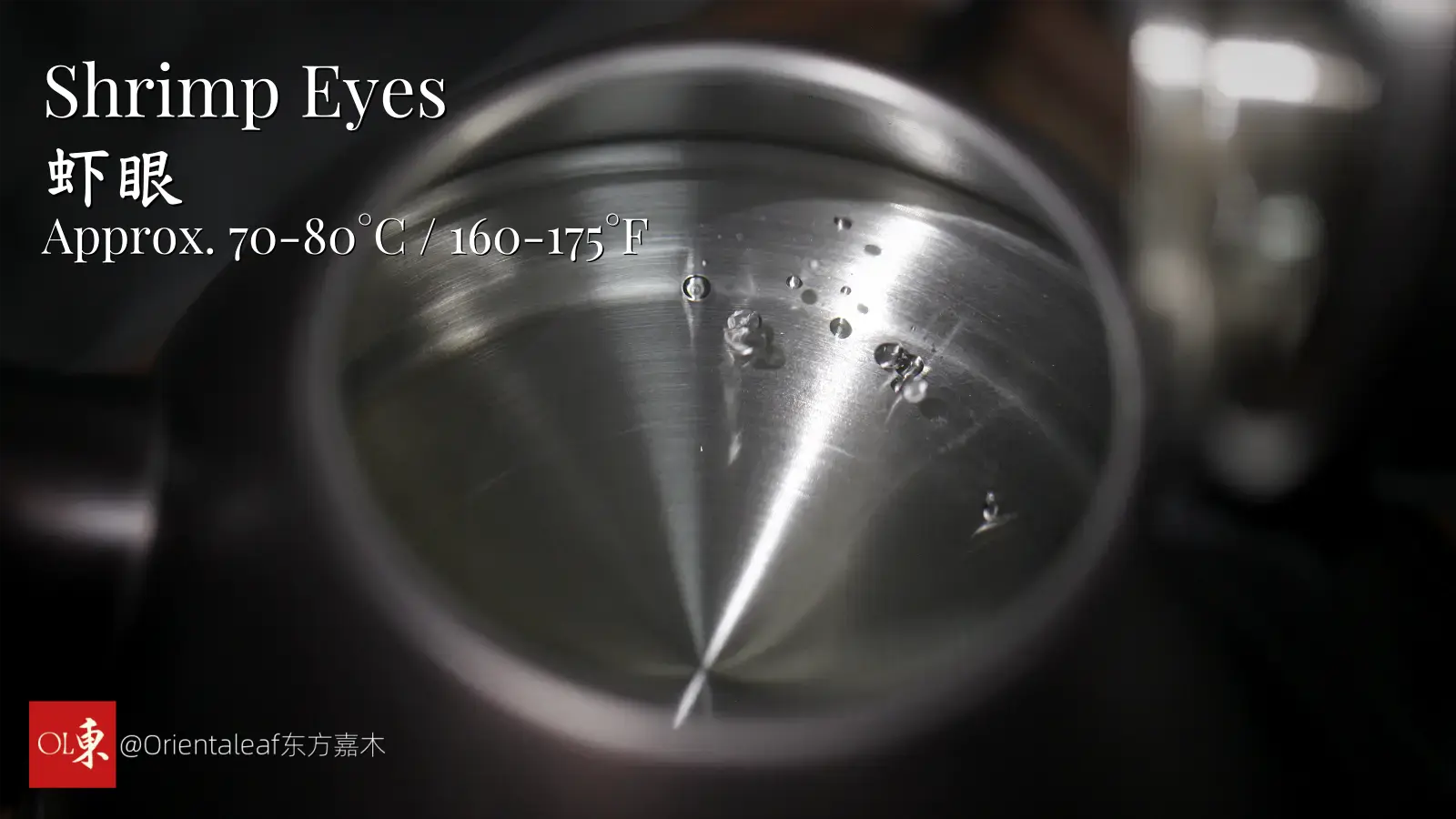
Shrimp Eyes
虾眼
Sight
A few small bubbles cling to the kettle bottom and sides
Sound
Nearly silent, whisper of steam
Steam
Barely visible wisps, fleeting
Best for these teas
How to Know Without Measuring
Sight
View the kettle from the side at eye level. Count bubbles and observe their movement. Stillness means cooler water; chaos means hotter.
Sound
Listen from arm's length away. Water progresses from silent to gentle hissing to clear rumble to forceful roar.
Steam
Watch vapor density. Thin wisps mean cooler; thick clouds rising rapidly mean hotter water ready for bold teas.
Temperature by Tea Category
Each tea type has an optimal temperature range for extraction.
| Tea Type | Optimal Range | Too Cool | Too Hot | Sensory Target |
|---|---|---|---|---|
White Tea White | 60 to 75°C | Flat, muted flavor. Under-extracted. | Bitter. Green qualities lost. | Delicate, floral, sweet |
Silver Needle White | 65 to 70°C | Barely perceptible flavor. | Flavor becomes harsh. | Subtle honey, orchid notes |
Sencha Green | 70 to 80°C | Green, grassy flavor remains thin. | Becomes bitter with astringency. | Vegetal sweetness, umami |
Gyokuro Green | 50 to 60°C | Completely muted. | The subtle structure collapses. | Deep umami, sweetness, oceanic |
Light Oolong Oolong | 75 to 85°C | Floral notes remain hidden. | Floral character becomes raw. | Floral, fruity, complex |
Medium Oolong Oolong | 85 to 95°C | Body feels thin. | Can be pushed to astringency. | Balanced fruit, floral, honey |
Dark Oolong Oolong | 90 to 100°C | Structure incomplete. | Properly extracted. | Deep roast, mineral, wood |
Black Tea Black | 95 to 100°C | Flat and one-dimensional. | Fully developed, assertive | Bold, malty, honey undertones |
Pu-erh (Sheng) Pu-erh | 80 to 90°C | Depth remains locked. | Medicinal notes may overwhelm. | Complex, earthy, sweet finish |
Pu-erh (Shou) Pu-erh | 95 to 100°C | Body thin, one-note. | Rich, smooth body emerges. | Smooth, earthy, deep |
The Cool-Down Method
After boiling, time your water cooling precisely for each tea type.
100°C
Rolling Waves
Ideal for
90°C
String of Pearls
Ideal for
85°C
Fish Eyes
Ideal for
80°C
Crab Eyes
Ideal for
70°C
Shrimp Eyes
Ideal for
How to Use the Cool-Down Method
- 1. Bring water to a full rolling boil in your kettle.
- 2. Based on your tea type, wait the indicated time before pouring.
- 3. After the wait time, the water will be at your target temperature.
- 4. Leave the kettle uncovered while cooling. Never recap it mid-cool.
- 5. After a few days of practice, you will internalize the timing and no longer need a timer.
From Calibration to Confidence
A three-phase approach to developing intuitive temperature judgment.
Phase 1
Calibration
Days 1 to 3
Build your baseline knowledge
Daily Focus
- ·Use a thermometer to check actual temperatures
- ·Observe the five stages with precise readings
- ·Record observations in a journal
- ·Practice identifying each stage 10 times
- ·Note variations in your kettle and environment
Outcome
Visual recognition of each stage is now reliable
Phase 2
Blind Testing
Days 4 to 10
Develop intuitive judgment
Daily Focus
- ·Hide the thermometer
- ·Estimate temperature after each brew attempt
- ·Verify your estimate afterward
- ·Brew different teas and adjust your calls
- ·Practice hearing and steam density cues
Outcome
You make accurate calls 8 out of 10 times
Phase 3
Mastery and Application
Days 11 and beyond
Brew with confidence and precision
Daily Focus
- ·Brew without any thermometer or timer
- ·Make fine adjustments based on tea type
- ·Teach others to judge temperature
- ·Understand how your specific kettle behaves
- ·Adapt to new kettles quickly
Outcome
Temperature judgment becomes an automatic skill
Your Learning Timeline
This is not a rigid timeline. Some people progress faster. Some take longer. The key is consistent daily practice. After the initial phase, the skill deepens indefinitely.
Tips for Faster Progress
- 1.Practice every day. Even 5 minutes daily beats occasional long sessions.
- 2.Use the same kettle for the first week. Learn its personality before changing.
- 3.Practice with the same tea type for 3 days before switching. Build one skill at a time.
- 4.Use all three senses. Sight alone is 40 percent of the information.
- 5.When you guess wrong, spend extra time understanding why. That is the real learning.
Common Mistakes and Fixes
Using boiling water for green or white tea
Consequence: Extraction increases 40 percent. Tea becomes bitter and astringent.
Fix: Wait for Crab Eyes stage, or steep for only 30 seconds at higher temps.
Judging temperature by sight alone
Consequence: You miss steam density and sound cues that confirm stage.
Fix: Always use all three senses: look, listen, observe steam.
Ignoring kettle type variations
Consequence: Metal kettles cool faster than ceramic. Timing varies.
Fix: Learn your specific kettle by practicing with a thermometer first.
Recapping the kettle mid-cool
Consequence: Traps heat. Water reboils unexpectedly.
Fix: Leave kettle uncovered during your cool-down wait time.
Not accounting for altitude
Consequence: At high elevation, water boils at lower temps. Kathmandu is 95°C, not 100°C.
Fix: Adjust expectations if you brew at altitude. Increase brew time slightly.
Ready to practice
Download the temperature reference card. Practice with your morning pot of water. After three days, you will feel the difference.